

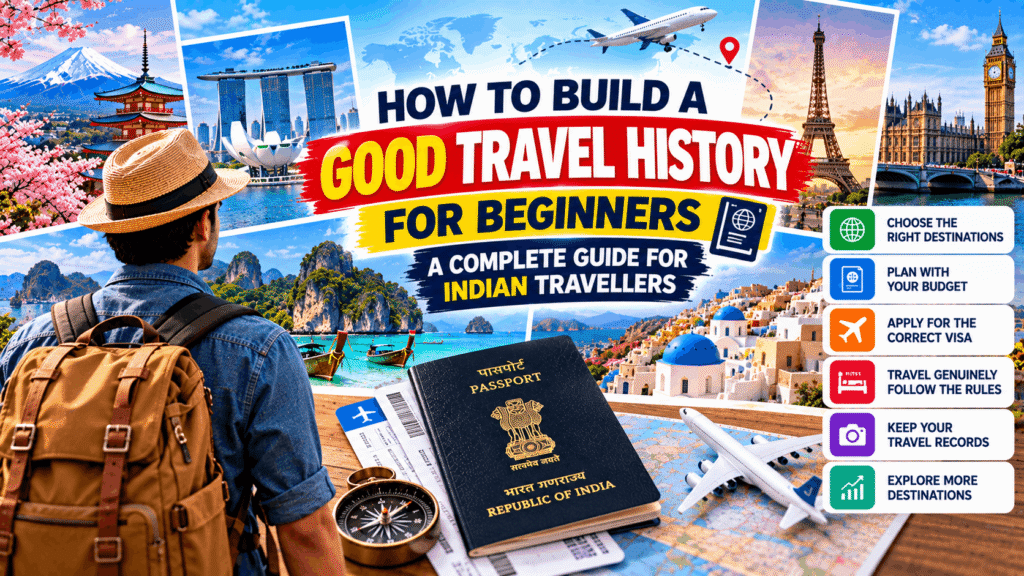
How to build good travel history for beginner travellers
If you’ve never travelled abroad before, you may have heard people say:
“You need good travel history before applying for visas.”
This can make first-time travellers worry that having a new or nearly empty passport will automatically make it difficult to travel internationally.
The reality is more nuanced.
Every frequent traveller started with a first international trip. Having previous international travel can sometimes form part of your overall profile when applying for future visas, but travel history alone does not guarantee visa approval, and having no travel history does not automatically mean your visa will be refused.
The best approach is to travel genuinely, follow immigration rules, maintain accurate records and gradually build an international travel history that reflects your real interests and circumstances.
This guide explains how beginners from India can build a genuine travel history step by step.
What Is Travel History?
Your travel history is simply your record of previous international travel.
Depending on the country and immigration system, evidence of previous travel may be reflected through:
Passport entry and exit stamps
Previous visas
eVisas
Electronic travel records
Residence permits
Previous passports
Immigration records
When a visa application asks about your travel history, you should provide accurate information according to the questions asked.
Why Can Travel History Be Relevant?
Previous travel can provide factual information about your international travel experience.
For example, it may show that you previously:
Travelled abroad → Complied with the permitted stay → Completed your trip → Returned as required
However, visa authorities consider applications according to their own immigration laws and requirements.
Depending on the visa, other factors may be equally or more important, including:
Genuine purpose of travel
Financial circumstances
Employment or business
Family and personal circumstances
Proposed itinerary
Supporting documentation
Immigration history
Previous visa refusals
Compliance with previous visas
Intention to comply with the conditions of the requested visa
Therefore, don’t treat passport stamps as a “score” that guarantees future visas.
Can You Get a Visa with No Travel History?
Yes, depending on the destination and whether you satisfy its visa requirements.
There is no universal rule saying an Indian traveller must first visit a specific number of countries before applying for another country’s tourist visa.
Someone applying for their first international trip naturally has zero international travel history.
If you genuinely want to visit a particular destination and satisfy its requirements, an empty passport should not automatically stop you from applying.
How to Build a Good Travel History Step by Step
1. Start with a Destination You Genuinely Want to Visit
Don’t visit countries merely to collect passport stamps.
Choose destinations based on your:
Budget + Interests + Available leave + Visa eligibility + Flight costs + Trip duration
For first-time Indian travellers, many people explore destinations in South Asia, Southeast Asia, the Middle East or other regions before taking longer trips.
The important point is not whether a country is considered “easy” or “difficult.”
Your trip should be genuine.
2. Choose a Trip You Can Comfortably Afford
Your first international holiday does not need to be expensive.
Suppose your available budget is limited.
Instead of forcing yourself into an expensive two-week long-haul holiday, you might plan a shorter international trip that comfortably fits your finances.
Calculate:
Flights + Visa + Hotels + Insurance + Local Transport + Food + Attractions + Shopping + Emergency Funds
A financially comfortable trip is generally better than taking unnecessary debt simply to create travel history.
3. Consider Short-Haul International Destinations
For beginners, shorter international trips can be easier to plan.
Depending on current visa and entry requirements, Indian travellers may consider destinations in regions such as:
South Asia
Southeast Asia
Middle East
Central Asia
East Asia
Flight duration and cost from India can sometimes be more manageable than long-haul travel.
However, visa and entry policies change frequently, so check the current official requirements for your chosen destination before booking.
4. Keep Your First Itinerary Simple
Your first international holiday doesn’t need to cover four countries in eight days.
A simple itinerary can be much easier to manage.
For example:
Day 1: Arrival
Day 2: City sightseeing
Day 3: Major attractions
Day 4: Day trip
Day 5: Shopping/local experiences
Day 6: Additional sightseeing
Day 7: Return to India
A straightforward itinerary reduces unnecessary transportation, hotel changes and logistical complications.
5. Apply for the Correct Visa
If your destination requires a visa, always apply under the correct category.
For tourism, use the appropriate tourist or visitor category.
Do not apply under another category merely because someone tells you it is easier.
Your:
Visa category + Travel purpose + Itinerary + Accommodation + Supporting documents
should be consistent.
6. Submit Genuine Documents
A strong travel history begins with genuine travel.
Never attempt to build it using:
Fake visas
Fake immigration stamps
Fabricated flight tickets
False hotel reservations
Altered bank statements
Fake employment letters
False business documents
Misleading travel information
Fraudulent documentation can create serious immigration consequences and damage future applications.
Building genuine travel history takes time. There is no legitimate shortcut.
7. Follow the Visa Conditions
Receiving a visa does not give you unlimited permission to stay in another country.
Follow the conditions attached to your visa or entry permission.
Pay attention to:
Permitted purpose + Number of entries + Validity + Permitted duration of stay
For example, don’t assume a visa’s expiry date necessarily means you are permitted to remain until that date. The rules governing permitted stay vary by destination and visa type.
8. Never Overstay
Overstaying can create significant immigration problems.
If you are permitted to stay for a particular period, plan to leave within the authorised period.
An overstay can potentially affect:
Future visa applications
Immigration records
Future entry decisions
Eligibility under certain immigration programmes
Don’t overstay simply because your return flight is cheaper a few days later.
Follow the immigration conditions applicable to your trip.
9. Preserve Your Previous Passports
When your passport expires and you receive a new one, don’t unnecessarily discard your old passport.
Previous passports may contain:
Visas
Entry stamps
Exit stamps
Other evidence of previous travel
Future visa applications may ask about previous passports or international travel.
Keep old passports safely.
10. Maintain Your Own Travel Records
Electronic immigration systems mean not every trip will necessarily produce the traditional collection of physical passport stamps travellers once expected.
Keep your own accurate record.
A simple travel-history table could contain:
| Country | Arrival | Departure | Purpose |
|---|---|---|---|
| Country A | 10 Jan 2026 | 15 Jan 2026 | Tourism |
| Country B | 20 Apr 2026 | 27 Apr 2026 | Tourism |
| Country C | 05 Sep 2026 | 12 Sep 2026 | Tourism |
You can also securely retain relevant old visa approvals and travel records.
This makes future visa forms easier to complete accurately.
11. Travel According to Your Genuine Interests
You don’t need to follow someone else’s travel sequence.
One traveller may love beaches and visit:
Thailand → Indonesia → Philippines
Another may prefer cities:
Singapore → Hong Kong → Japan
Another may enjoy mountains and culture:
Nepal → Japan → Switzerland
There is no universal “perfect” order.
Your travel history should represent where you genuinely wanted to travel.
12. Gradually Explore More Destinations
If you enjoy international travel and your budget allows, you can gradually expand your destinations.
For example, your personal travel journey might evolve from:
Nearby international destinations
↓
Southeast Asian holidays
↓
East Asian destinations
↓
Middle Eastern destinations
↓
European holidays
↓
Long-haul destinations
But this is a travel-planning approach—not an immigration requirement.
You do not need to complete one region before you are “allowed” to apply for another.
13. Don’t Travel Solely to Make Another Visa Look Stronger
This is an important distinction.
You may see advice online such as:
“Visit five easy countries, then apply for Europe.”
or
“Get these three visas before applying for the USA.”
Treat such formulas cautiously.
Visa decisions are made under the requirements of the destination country and the individual circumstances of the applicant.
There is no universal mathematical formula such as:
5 countries visited = Schengen approval
or
10 countries visited = USA visa approval
International travel should primarily be about genuine travel—not manufacturing an immigration profile.
14. Build Financial Stability Alongside Travel History
When visa-required destinations assess applications, your overall circumstances can matter.
Therefore, instead of focusing exclusively on passport stamps, maintain genuine and well-documented finances.
Depending on your circumstances, this could include:
Regular income
Savings appropriate to your lifestyle
Salary records
Business income
Income-tax records
Genuine bank activity
Avoid suddenly borrowing large amounts of money simply to display an impressive bank balance for a visa application.
If a large transaction is legitimate, retain appropriate evidence and explain it if required.
15. Maintain Genuine Employment or Business Records
Your professional circumstances can also be relevant to certain visa applications.
For Employees
Maintain genuine records such as:
Employment evidence + Salary records + Leave approval + Tax documents where applicable
For Business Owners
Maintain appropriate:
Business registration + Tax records + Business banking + Company documents + Genuine business activity
For Students
Keep relevant:
Student ID + Institution records + Academic documents + Sponsorship evidence where applicable
The exact documents required depend on the destination and visa category.
16. Don’t Hide Previous Visa Refusals
A refusal is not something you should attempt to erase from your travel history.
If a future visa application asks whether you’ve previously been refused a visa, answer truthfully.
Read the previous refusal carefully and understand the stated reasons.
Where appropriate, a future application can address changed circumstances or provide stronger evidence relevant to the previous concerns.
Never provide false information simply because you’re worried that a previous refusal will affect your application.
17. Avoid Unnecessary Back-to-Back Trips
There is no need to rush through several countries merely to increase the number of destinations on your travel history.
For example:
January – Country A
February – Country B
March – Country C
April – Country D
can be perfectly legitimate if frequent travel suits your finances, occupation and interests.
But if you’re doing it only because someone promised that “four stamps will get your next visa approved,” reconsider the strategy.
Quality and genuineness matter more than collecting stamps.
18. Understand That Visa-Free Travel Still Counts as Travel
Travel history is broader than sticker visas.
Depending on how a country records entry, your international travel can involve:
Visa-free entry
eVisa
Visa on arrival
Electronic authorisation
Sticker visa
A genuine international trip remains part of your travel history even if no large visa sticker appears in your passport.
Keep accurate records of your journeys.
19. Don’t Assume Expensive Countries Create “Better” Travel History
Visiting an expensive destination doesn’t automatically make your travel history superior.
A genuine holiday to a nearby country is still international travel.
Immigration authorities apply their own criteria when considering future visa applications.
Instead of thinking:
“Which passport stamp looks strongest?”
think:
“Where do I genuinely want to travel, and can I comfortably afford the trip?”
20. Respect Immigration Laws Everywhere You Travel
The best travel history is a compliant travel history.
During your trips:
✓ Follow visa conditions
✓ Leave within the authorised period
✓ Don’t work illegally
✓ Respect local laws
✓ Provide truthful information to immigration authorities
✓ Keep your documents secure
Responsible travel habits matter far more than simply increasing your country count.
A Practical Beginner Travel-History Roadmap
If you’re completely new to international travel, you can use this framework:
Stage 1 – Get Your Passport Ready
Check your passport before planning international travel.
The Government of India’s Passport Seva advises travellers to check passport validity and available visa pages before international travel.
Stage 2 – Choose Your First Genuine Destination
Consider:
Budget + Visa requirements + Flight cost + Interests + Available time
Stage 3 – Plan a Manageable Trip
A 4–7 day trip to one destination can be easier for a beginner than a complicated multi-country itinerary.
Stage 4 – Follow Entry and Exit Rules
Understand exactly how long you are permitted to stay.
Stage 5 – Keep Your Travel Records
Save relevant visa approvals, old passports and travel information.
Stage 6 – Take Your Next Trip When You’re Ready
Choose your next destination based on your interests and finances rather than rushing to accumulate passport stamps.
Stage 7 – Apply for More Visa-Intensive Destinations When They Fit Your Plans
When you’re ready for destinations such as Japan, the Schengen Area, the UK, Australia, Canada or the USA, review the current visa requirements and apply based on your genuine circumstances.
Previous travel may form part of your profile, but it should not be treated as a substitute for satisfying the visa requirements.
Example Travel Progression for a Beginner
There is no mandatory route, but a traveller interested in gradually expanding their international experiences might personally choose something like:
Trip 1: Nearby Asian destination
↓
Trip 2: Southeast Asia
↓
Trip 3: East Asia or Middle East
↓
Trip 4: Japan or South Korea
↓
Trip 5: Europe
↓
Trip 6: Longer-haul destinations
This is only an example of travel progression.
You can absolutely apply for a destination earlier if that is where you genuinely want to go and you meet its requirements.
Does Good Travel History Guarantee a Visa?
No.
This is one of the biggest misconceptions in visa planning.
Someone may have visited 15 countries and still have a visa application refused.
Another person may have very limited international travel and receive a visa.
Visa authorities assess applications according to their own legal requirements and the applicant’s circumstances.
Travel history should therefore be viewed as one factual part of your profile—not a guarantee of approval.
Common Mistakes Beginners Should Avoid
Avoid:
Travelling only to collect passport stamps
Applying for visas using fake documents
Creating fake flight or hotel bookings
Overstaying a visa
Working while admitted only as a tourist where prohibited
Hiding previous visa refusals
Borrowing money solely to show an artificial bank balance
Choosing destinations you cannot comfortably afford
Believing agents who promise guaranteed visa approval
Assuming more countries automatically mean a stronger visa application
There is no shortcut worth damaging your immigration record.
Beginner’s International Travel Checklist
Before your first trip:
✓ Check passport validity
✓ Check destination visa requirements
✓ Apply for the correct visa where necessary
✓ Prepare genuine documents
✓ Create a realistic itinerary
✓ Book appropriate flights and accommodation
✓ Check transit requirements
✓ Consider suitable travel insurance
✓ Arrange foreign currency/payment methods
✓ Keep emergency funds
✓ Understand entry conditions
✓ Know your permitted duration of stay
✓ Return within the authorised period
✓ Keep your old passport and travel records
The Government of India’s Passport Seva is the official source for Indian passport services and also warns travellers about fraudulent passport-service websites.
How Travel Ventures Can Help First-Time International Travellers
Planning your first international journey can involve passports, visas, flights, hotels, insurance and unfamiliar immigration requirements.
Travel Ventures can assist with:
Passport services
Tourist visa application guidance
Visa appointment assistance
Visa documentation guidance
International flight bookings
Hotel accommodation
Travel insurance
International tour packages
Foreign currency exchange
Day-to-day itinerary planning
First-time international travel guidance
Whether you’re planning your first passport stamp or your tenth international holiday, the goal should remain the same: travel genuinely, follow the rules and enjoy discovering new destinations.
Build Experiences, Not Just Passport Stamps
A good travel history isn’t created by racing through as many countries as possible.
It develops naturally when you:
Travel genuinely → Follow immigration rules → Return within the permitted stay → Keep accurate records → Maintain genuine finances → Gradually explore more destinations
Don’t let an empty passport discourage you.
Every experienced international traveller once opened a passport with no visas and no stamps.
Start with a destination you genuinely want to experience, plan within your budget and travel responsibly.
Over time, your passport will become a record not only of where you’ve travelled—but of the experiences you’ve collected along the way.
Planning your first international holiday? Contact Travel Ventures for passport assistance, tourist visas, visa appointments, flights, hotels, travel insurance and customised international tour packages.
Disclaimer: Previous travel does not guarantee approval of any future visa. Visa, immigration and entry requirements vary by country and may change. Visa decisions are made solely by the relevant embassy, consulate or immigration authority. Travellers should verify current requirements through official sources before applying or travelling.