

Add Your Heading Text Here
You’ve received your visa, booked your flight, reserved your hotel and finally landed at your international destination.
There is still one important step before your holiday officially begins:
Immigration and border control.
For first-time international travellers, speaking with an immigration or border officer can feel intimidating. In most cases, however, the questions are straightforward and relate to your identity, purpose of travel, duration of stay, accommodation, finances and onward or return plans.
The exact questions and entry procedures vary by country, and an officer may ask additional questions depending on your circumstances.
The best preparation is simple:
Know your genuine travel plans, keep relevant documents accessible and answer truthfully.
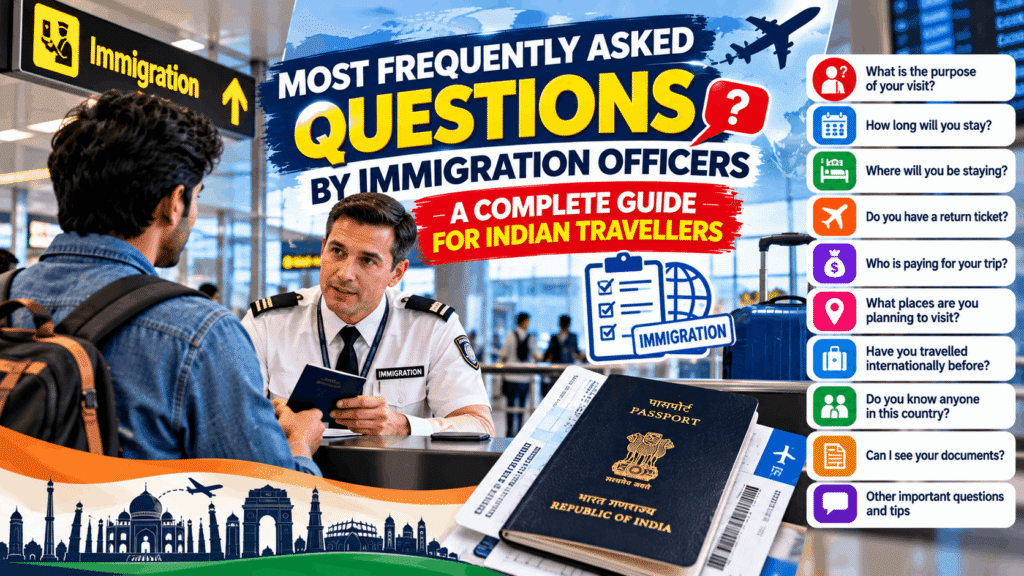
This guide covers some of the most frequently asked immigration questions for Indian international travellers and explains how to approach them confidently.
Why Do Immigration Officers Ask Questions?
A visa and immigration clearance are not necessarily the same thing.
Where applicable, a visa generally allows you to travel to a country’s border and request admission under the relevant category. Border authorities may then determine whether you satisfy the entry requirements.
An immigration officer may seek to confirm:
- Your identity
- Purpose of travel
- Duration of stay
- Accommodation
- Return or onward plans
- Financial ability to support the trip
- Whether your answers are consistent with your documents
- Whether you satisfy applicable entry conditions
The questions are not a test that requires memorised answers.
They are primarily about your actual journey.
1. What Is the Purpose of Your Visit?
This is one of the most common immigration questions.
Your answer should correspond with your genuine reason for travelling and, where applicable, your visa or entry category.
Example
Officer: What is the purpose of your visit?
Traveller: I’m visiting Japan for tourism. I’ll be spending eight days visiting Tokyo, Kyoto and Osaka.
Keep it simple.
Don’t give a five-minute explanation when one or two sentences answer the question.
2. How Long Will You Stay?
Know the exact duration of your trip.
Example
Officer: How long are you staying?
Traveller: I’ll be staying for eight days. I return to India on 18 November.
Your answer should be consistent with your actual itinerary and travel arrangements.
Avoid vague answers such as:
“Maybe two weeks.”
if you already have a confirmed eight-day itinerary.
3. Where Will You Be Staying?
The officer may ask for your accommodation details.
Know at least the name and location of your first hotel.
Example
Officer: Where are you staying?
Traveller: I’m staying at a hotel in Shinjuku, Tokyo for the first four nights, and then I’ll travel to Kyoto.
Keep your hotel confirmation easily accessible.
If you’re staying with a friend or relative, provide truthful information about that arrangement.
4. Do You Have a Return Ticket?
Border officials may want to understand your departure plans.
Example
Officer: Do you have a return ticket?
Traveller: Yes. My return flight to Chennai is on 18 November.
If requested, show your actual booking confirmation.
Never create or present a fake return ticket.
5. What Places Are You Planning to Visit?
You don’t need to memorise every attraction, but you should understand your itinerary.
Example
Officer: What places are you planning to visit?
Traveller: I’ll visit Tokyo first, take a day trip around the Mount Fuji area, then travel to Kyoto and Osaka.
This demonstrates that you know your own travel plans.
6. Is This Your First Visit?
The officer may ask whether you’ve visited that country before.
Example – First Visit
Officer: Is this your first visit to Japan?
Traveller: Yes, this is my first visit.
Example – Returning Traveller
Traveller: No. I previously visited Japan in January 2025 for tourism.
Answer according to your actual travel history.
7. Have You Travelled Internationally Before?
You may be asked about previous international travel.
Example
Officer: Have you travelled abroad before?
Traveller: Yes, I’ve previously travelled internationally for tourism.
If the officer asks which countries, answer accurately.
If this is your first international trip, simply say:
“No, this is my first international trip.”
Having no previous travel history is not a reason to invent one.
8. What Do You Do in India?
The officer may ask about your occupation.
Example – Employee
Officer: What do you do in India?
Traveller: I work as a software engineer in Chennai.
Example – Business Owner
Traveller: I’m self-employed and run my own business in Chennai.
Example – Student
Traveller: I’m a university student in India.
Give a factual answer appropriate to your circumstances.
9. Who Is Paying for Your Trip?
The officer may ask how the trip is being funded.
Example – Self-Funded
Officer: Who is paying for your trip?
Traveller: I’m paying for the trip myself from my savings and income.
Example – Sponsored
Traveller: My father is sponsoring my trip.
If someone else is genuinely sponsoring your travel, understand the arrangement and carry any supporting documents required for your destination.
10. How Much Money Are You Carrying?
An officer may ask about the funds available for your stay.
You might be using:
Cash + Credit/Debit Card + Forex Card + Other legitimate payment methods
Answer accurately.
Be aware that countries may impose declaration requirements when travellers carry cash or monetary instruments above specified thresholds.
Never conceal money that must legally be declared.
11. What Is Your Travel Itinerary?
The officer may want a brief summary.
You do not need to recite your itinerary minute by minute.
Example
Officer: What’s your itinerary?
Traveller: I’m spending four nights in Tokyo, two nights in Kyoto and two nights in Osaka before returning to India.
Short, specific and accurate is usually sufficient unless the officer requests more detail.
12. Are You Travelling Alone?
Simply answer according to your circumstances.
Example
Officer: Are you travelling alone?
Traveller: Yes, I’m travelling solo.
Or:
Traveller: No, I’m travelling with my wife and parents.
Solo travel is common. There is no need to invent a travel companion.
13. Do You Know Anyone in This Country?
If asked, answer truthfully.
Example
Officer: Do you have relatives or friends here?
Traveller: Yes, my sister lives here.
or:
Traveller: No, I don’t have any relatives here. I’m visiting purely for tourism.
Don’t hide a relative merely because you’re worried about how the answer may be perceived.
Truthful disclosure is important.
14. Are You Staying with a Relative or Friend?
If yes, know:
- Their name
- Your relationship
- Their address
- Your accommodation arrangement
Example
Officer: Where will you stay?
Traveller: I’ll be staying with my sister in New York for the first four days and then at a hotel in Washington, D.C.
Only use an answer like this if it accurately describes your trip.
15. What Does Your Relative or Friend Do?
If you’re visiting or staying with someone, you may be asked basic questions about them.
For example:
Officer: What does your sister do?
Answer according to what you genuinely know.
Do not invent an occupation or other information because you think a particular answer sounds better.
16. Why Did You Choose This Country?
This is usually straightforward.
Example – Switzerland
Officer: Why did you choose Switzerland?
Traveller: I’m interested in the Alpine scenery and plan to visit Zurich, Lucerne and Interlaken.
Example – Japan
Traveller: I’ve wanted to experience Japanese culture and visit Tokyo, Kyoto and Osaka.
Use your real travel interests.
17. How Long Are You Staying at This Hotel?
Know your hotel dates.
For multi-city travel, be ready to explain when you move to the next destination.
Example
Traveller: I’m staying here for four nights, then taking the train to Kyoto for two nights.
Your hotel reservations and itinerary should be consistent.
18. What Is Your Return Date?
Know the date.
Example
Officer: When are you returning to India?
Traveller: My return flight is on 18 November.
Avoid saying:
“I think around the 18th.”
when your ticket clearly shows a confirmed date.
19. Why Are You Travelling Alone?
Solo travellers may occasionally be asked why they are travelling alone.
There is nothing unusual about solo tourism.
Example
Traveller: I enjoy travelling independently, and this trip fits my personal schedule.
Use your genuine reason.
20. How Much Did Your Trip Cost?
An officer may ask about your approximate budget.
You don’t need to calculate every rupee at the counter, but you should understand roughly what your trip costs.
For example:
Flights + Hotels + Transportation + Food + Attractions + Personal expenses
Example
Traveller: I’ve budgeted approximately ₹1.5 lakh for the trip, including flights and accommodation.
Only state figures that are accurate for your trip.
21. Do You Have Travel Insurance?
If you have insurance, keep the policy information accessible.
Example
Officer: Do you have travel insurance?
Traveller: Yes.
If requested, show the relevant certificate or policy details.
For destinations or visa categories where travel insurance is mandatory, ensure your policy satisfies the applicable requirements.
22. What Do You Plan to Do During Your Stay?
This is another way of asking about your purpose and itinerary.
Example
Traveller: I’m here for tourism. I’ll spend four days sightseeing in Paris and then travel to Switzerland for six days.
Your answer should match your actual plans.
23. Are You Planning to Work Here?
If you are entering as a tourist and are not authorised to work, your plans must comply with that status.
Example
Officer: Are you planning to work here?
Traveller: No. I’m visiting only for tourism.
Do not use a tourist entry category to undertake employment that requires separate authorisation.
24. When Did You Book Your Trip?
You may be asked about your travel arrangements.
Simply provide the correct information.
You don’t need to memorise the exact booking timestamp unless relevant. Know the general circumstances of your own trip and have confirmations available.
25. Can I See Your Hotel Booking?
If requested, provide your genuine reservation.
It is useful to have your hotel confirmation available on your phone and, where practical, an offline copy.
Ensure that:
Guest name + Hotel + Dates + Destination
are consistent with your itinerary.
26. Can I See Your Return Flight?
Have your return or onward itinerary easily accessible.
Avoid searching through hundreds of emails while standing at immigration.
Before departure, create a dedicated travel folder on your phone containing your important documents.
27. Can I See Proof of Funds?
Whether this is requested depends on the destination and circumstances.
Relevant evidence could include appropriate financial information or payment methods.
Carry whatever documentation is required by your destination’s current entry rules.
Never present manipulated screenshots or fabricated financial documents.
28. How Do You Know the Person You’re Visiting?
This may be relevant when visiting friends or relatives.
Example
Officer: How do you know your host?
Traveller: She’s my elder sister.
or:
Traveller: He’s a university friend I’ve known for several years.
Again, answer factually.
29. Have You Ever Been Refused a Visa?
If asked about a previous refusal, answer truthfully.
Example
Officer: Have you ever had a visa refused?
Traveller: Yes, I previously had a visa application refused.
If the officer asks for more information, provide an accurate explanation.
Do not attempt to hide a refusal where disclosure is required.
30. Have You Ever Overstayed a Visa?
Answer this carefully and truthfully.
Immigration authorities may have access to previous immigration records.
If you have never overstayed:
“No.”
If you have, do not provide false information. Explain accurately if asked.
Documents to Keep Ready at Immigration
You do not necessarily need to physically hand over every document immediately.
Keep relevant documents organised and provide them when requested.
A useful arrival folder may contain:
✓ Passport
✓ Valid visa/eVisa/travel authorisation where applicable
✓ Boarding pass
✓ Return/onward flight confirmation
✓ Hotel booking
✓ Travel itinerary
✓ Travel insurance
✓ Host details if staying with someone
✓ Financial evidence where relevant
✓ Supporting documents required by your destination
Store essential documents securely and make sure important information can be accessed even if airport Wi-Fi is unavailable.
How Should You Answer Immigration Questions?
The most effective approach is straightforward:
1. Tell the Truth
Never create a story simply because you think it sounds more convincing.
2. Listen to the Entire Question
Don’t rush to answer before the officer finishes speaking.
3. Answer the Question Asked
If the officer asks:
“How many days are you staying?”
you can simply answer:
“Eight days.”
You don’t necessarily need to explain your entire itinerary unless asked.
4. Know Your Own Trip
Know your:
Destination → Hotels → Travel dates → Return flight → Main attractions → Trip budget
5. Keep Documents Organised
Being able to retrieve requested documents quickly makes the process easier.
6. Don’t Memorise Scripts Word-for-Word
Memorised answers can sound unnatural and may become confusing if the officer asks the same question differently.
Understand your trip rather than memorising a script.
7. Ask for Clarification if Necessary
If you genuinely don’t understand a question, politely ask the officer to repeat or clarify it.
Don’t guess what was asked.
What NOT to Say at Immigration
Avoid jokes, false statements or unnecessarily confusing answers.
For example, if you’re genuinely entering for a short holiday, don’t joke:
“Maybe I’ll stay forever!”
Don’t say:
“My agent prepared everything, so I don’t know where I’m staying.”
And never provide an answer you know is false.
Your answers should accurately describe your actual travel plans.
First-Time Traveller Immigration Example
Imagine you’re an Indian traveller visiting Japan for seven days.
Officer: Purpose of your visit?
You: Tourism.
Officer: How long will you stay?
You: Seven days.
Officer: Where are you staying?
You: Four nights in Tokyo and three nights in Osaka.
Officer: What are you planning to visit?
You: Tokyo, the Mount Fuji area and Osaka.
Officer: When are you returning?
You: My return flight to India is on 20 November.
That’s the general idea.
Short + Clear + Truthful + Consistent.
Immigration Questions for USA Visitors
Travellers entering the United States may be asked questions relating to matters such as:
Purpose of visit
Duration
Accommodation
Return plans
Who is paying
People being visited
Previous U.S. visits
Travel plans
A U.S. visa does not itself guarantee admission. U.S. Customs and Border Protection determines admissibility at the port of entry.
If you’re visiting on an appropriate B1/B2 visitor visa, ensure your actual activities comply with your visitor status.
Immigration Questions for Schengen/European Travel
At the Schengen external border, travellers may be asked to provide information or supporting documentation relating to the conditions of entry.
Be prepared to explain:
Purpose of visit
Duration
Accommodation
Travel itinerary
Return/onward plans
Means of subsistence
Travel insurance where applicable
For a multi-country European trip, know which countries you’re visiting and the approximate number of days in each.
Immigration Questions for Japan
Visitors arriving in Japan should know their:
Purpose of visit
Duration
Accommodation
Travel itinerary
Departure plans
Japan also has customs and immigration procedures for arriving travellers.
Make sure your actual activities remain consistent with the status under which you entered Japan.
Immigration Questions for Singapore
Travellers entering Singapore should be prepared to satisfy current entry requirements and explain their genuine travel plans if questioned.
Know your:
Accommodation
Length of stay
Purpose
Return/onward journey
Travel arrangements
Also ensure you complete any required pre-arrival formalities using official channels.
Immigration Questions for Dubai / UAE
Visitors to the UAE may similarly be asked about:
Purpose of visit
Length of stay
Accommodation
Return/onward flight
Travel plans
Carry the documentation required for your visa and entry circumstances.
Common Immigration Mistakes to Avoid
First-time international travellers should avoid:
Giving false answers
Providing inconsistent travel dates
Not knowing the hotel name
Not knowing the return date
Presenting fake bookings
Hiding relevant information when directly asked
Carrying prohibited items
Ignoring customs declaration requirements
Providing documents that contradict your answers
Working without appropriate authorisation
Overstaying the permitted period
Making inappropriate jokes about immigration, security or prohibited activities
Preparation does not mean inventing a better story.
It means knowing your real story.
Final Immigration Checklist
Before joining the immigration queue, confirm:
✓ Passport ready
✓ Visa/eVisa ready where required
✓ Arrival documentation completed where applicable
✓ Hotel address saved
✓ Return/onward flight accessible
✓ Travel itinerary accessible
✓ Insurance information available
✓ Host information available where applicable
✓ Required financial/supporting evidence accessible
✓ Phone charged
✓ Internet or offline document access available
✓ Customs rules understood
Most importantly:
Know why you’re travelling, where you’re staying, how long you’re staying and when you’re leaving.
How Travel Ventures Can Help First-Time International Travellers
International travel can feel complicated when you’re handling visas, documentation, flights, hotels and immigration procedures for the first time.
Travel Ventures can assist with:
Tourist visa application guidance
Visa appointment assistance
Passport services
International flight bookings
Hotel accommodation
Travel insurance
Foreign currency exchange
International tour packages
Travel itinerary preparation
Pre-departure travel guidance
General immigration interview preparation for tourists
Our focus is helping travellers understand their genuine itinerary and organise the relevant documentation—not teaching applicants to provide misleading answers.
Be Prepared, Not Nervous
Immigration interviews are easier when you understand your own trip.
Remember:
Know your purpose → Know your itinerary → Know your hotel → Know your return date → Keep documents ready → Answer truthfully
You don’t need complicated answers.
You need accurate ones.
If you’re a first-time international traveller, prepare your documents before departure and familiarise yourself with your itinerary. When the officer asks a question, listen carefully and answer naturally.
Then, once you’ve completed the required entry formalities, you can get on with the best part of the journey—enjoying your destination.
Planning your next international trip? Contact Travel Ventures for tourist visa assistance, passport services, flights, hotels, travel insurance, foreign currency and customised international tour packages.
Disclaimer: Immigration and border-entry procedures vary by country and individual circumstances and can change. A visa does not necessarily guarantee admission. Final entry decisions are made by the relevant border or immigration authorities. Travellers should verify current entry, customs and immigration requirements through official government sources before departure.